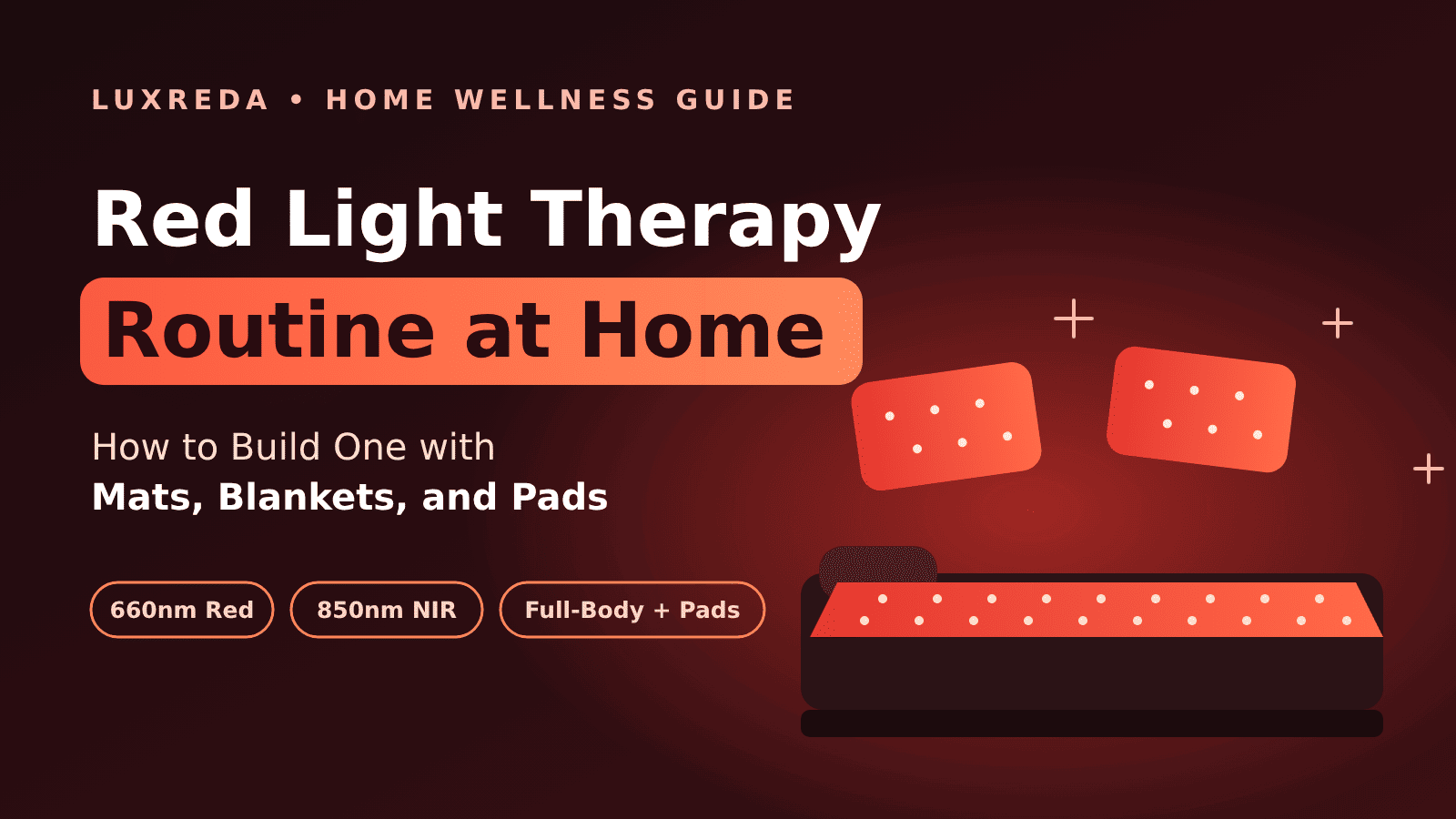
A good wellness routine should fit your life, not take it over. Most of us already make small pockets of time to stretch, unwind, or reset after a long day. A red light therapy routine at home can slide into those moments without much fuss.
The short answer: choose a setup you will actually use, follow the manufacturer’s instructions, and keep your sessions consistent. A full-body mat or blanket works well for lying-down sessions. Targeted pads work well for one area at a time, like your shoulders or lower back.
This guide shows you how to choose between those formats and plan a realistic week. You will also learn what to avoid and where the LuxReda FlexiRed™ fits.

What a Home Light Therapy Routine Looks Like
Think of a routine as three simple decisions: where the light goes, how often you sit down, and when it fits your day.
Most at-home red light therapy sessions follow the same pattern:
- You set up the device on a bed, sofa, or yoga mat.
- You choose a mode and brightness level.
- You relax while the device runs for the time the manufacturer recommends.
- You wrap up and note how the session felt.
That last step matters more than people expect. A short note on your phone helps you see whether your routine feels comfortable and easy to keep.
The best routine is the one you can repeat. A 15-minute habit you keep up beats an ambitious plan you drop after two weeks. Small, steady habits tend to stick, and they make self-care feel less like a chore.
Full-Body vs. Targeted Light: Which Fits You?
Full-body and targeted setups both have a place. Your daily habits decide which one makes more sense.
| Question | Full-body mat or blanket | Targeted pads |
|---|---|---|
| Where do you want light? | Several areas in one sitting | One area at a time |
| How do you like to relax? | Lying down | Sitting or reclining |
| Time available | A single longer, relaxed session | Short sessions in a spare moment |
| Storage and travel | Needs more space | Easier to tuck away |
When a Mat or Blanket Makes Sense
A full-body setup suits people who like a lie-down reset. It covers your back, legs, and arms in one go. Many people use it in the evening, after a workout, or on weekend mornings.
When Pads Make Sense
Pads give you flexibility. If your shoulders tighten at your desk or your knees feel stiff after a run, you can place a pad right where you want it. You can also pair them with a mat on days you want broader coverage.
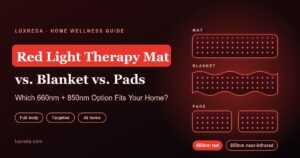
Still deciding between formats? LuxReda’s detailed red light therapy mat vs. blanket vs. pads comparison walks through each one side by side.
660nm and 850nm: What the Two Wavelengths Mean
Many home devices pair two wavelengths. Understanding them helps you read product pages with a clearer eye.
660nm is visible red light. 850nm is near-infrared light, which you cannot see. Researchers who study photobiomodulation usually describe the red range as roughly 600 to 700 nm and the near-infrared range as roughly 780 to 1100 nm. This NIH-hosted review of proposed mechanisms explains why those ranges draw interest.
Here is the honest part. Science on light therapy is still developing. Scientists at the National Institute on Aging noted that the specific mechanisms of action of PBM are not entirely understood and the methodology of various light therapies is ill-defined, in their workshop summary on photobiomodulation. nih
So treat any device as a wellness tool, not a treatment. Your routine should aim at comfort, relaxation, and consistency. For a deeper look at how the two wavelengths differ in a mat format, see LuxReda’s guide to 660nm vs. 850nm red light therapy mats.
How to Build Your Routine in Five Steps
You do not need a complicated plan. Work through these five steps in order.
Step 1: Pick Your Main Goal
Ask yourself what you want from the routine. Maybe you want a calm wind-down ritual. Maybe you want a post-workout reset or a short daily pause. A clear goal keeps your plan simple.
Step 2: Match the Format to Your Goal
Use a mat or blanket for whole-body relaxation sessions. Use pads for specific areas you think about often. Many people combine both formats over a week.
Step 3: Choose a Time You Can Repeat
Anchor your session to something you already do. Try after your morning coffee, right after a workout, or before dinner. If you want an evening slot, you may also like LuxReda’s article on red light therapy for sleep.
Step 4: Start Gentle and Follow the Instructions
Begin with the shortest session time and lowest brightness the manufacturer recommends. Do not guess at session length or distance. Check the instructions that come with your device. If something is unclear, contact the seller before your first session.
Step 5: Track and Adjust
Keep a simple log for a few weeks. Write the date, the area, the mode, and how you felt. After a month, you will see which sessions you enjoy and which ones you skip. Adjust from there.
A sample week might look like this, using your own device’s recommended session lengths:
- Monday: full-body session after work to unwind.
- Wednesday: pad on tight shoulders during a quiet reading break.
- Friday: full-body session after a workout. For more on this, read about a red light therapy blanket for muscle recovery.
- Weekend: an optional relaxed session, or a rest day.
Rest days are part of a healthy routine too. Your body and your schedule both need breathing room.
Where LuxReda FlexiRed™ Fits In
The LuxReda FlexiRed™ Therapy Mat, Blanket & Pads (660nm + 850nm) fits this routine idea because one system covers both formats. LuxReda lists it as a 3-in-1 design that supports full-body and targeted use.
These details come from the official product page:
- Wavelengths: 660nm red and 850nm near-infrared in a 2:1 ratio.
- Formats: mat, blanket, and pads.
- Modes: dimming mode and pulse mode.
- Size options: 63 × 24 inches and 71 × 32 inches.
- Material: soft, flexible fabric that LuxReda describes as lightweight and foldable.
- Power: maximum 110W / 130W, with 24V / 5A input.
- Warranty: one year.
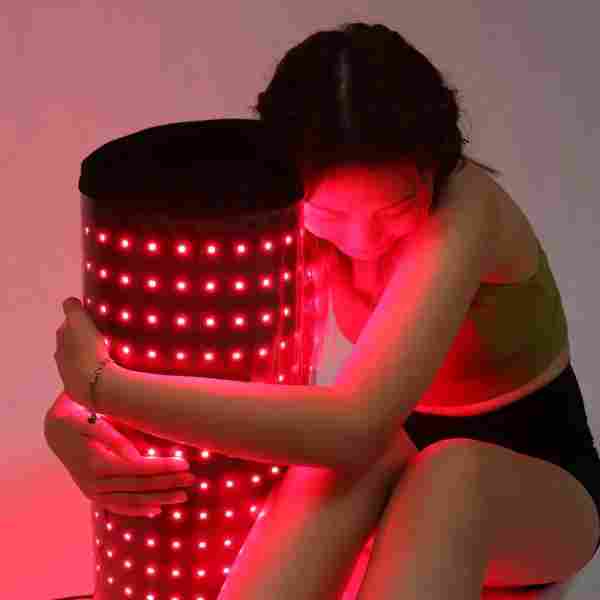
The flexible fabric means you can lay it flat on a bed, sofa, or floor, or wrap it around an area. The dimming mode lets you adjust intensity as you build your routine. LuxReda does not publish irradiance numbers on the product page, so ask the company if you need that detail.
Before you buy, think about three practical points:
- Space: measure your bed, sofa, or floor area against the size options.
- Storage: decide where you will fold and store it.
- Format: choose the mat or pads based on your goal, not on looks.
You can also read how to use a red light therapy mat for a general walkthrough of setup and positioning.
Safe Use and Common Mistakes
A calm, careful approach protects both your comfort and your enjoyment of the routine.
Safety Basics
- Follow the manufacturer’s instructions for session length, distance, and settings.
- Protect your eyes as the instructions direct, and avoid staring at bright LEDs.
- Stop if anything feels uncomfortable, including unusual warmth.
- Talk to your doctor first if you are pregnant, take medication, have a medical condition, or have concerns about light exposure.
The FDA has published draft guidance on photobiomodulation devices. It also notes that some low-risk products meant only for general wellness may fall outside that guidance. Check how any brand describes its product, and look past big promises.
Mistakes to Avoid
- Doing too much too soon. Start short and build slowly.
- Skipping the instructions. Settings differ between devices.
- Expecting overnight results. Treat the routine as a long-term habit.
- Changing everything at once. Adjust one thing at a time so you know what you like.
- Treating light therapy as a replacement for medical care. It is not.
Frequently Asked Questions
Follow your device’s instructions. Many people settle into a routine of several sessions per week, but the right schedule depends on your device and comfort. Start gently and keep a log.
Choose by how you like to relax. A mat or blanket suits lying-down sessions. Pads suit specific areas and short breaks. A flexible system like FlexiRed™ lets you do both.
660nm is visible red light. 850nm is near-infrared, which you cannot see. Many home devices combine them. Research continues, so treat them as wellness tools.
It depends on the device. Use the session length in the manufacturer’s instructions rather than copying a number from the internet.
LuxReda’s product page describes FlexiRed™ as suitable for daily, non-invasive use. Still, daily use is a personal choice. If you have any health concerns, ask your doctor first.
No. It is a home wellness tool. See a healthcare professional for any medical concern.
Conclusion: Start Small and Stay Consistent
A red light therapy routine at home works best when it feels easy. Pick one goal, choose the format that suits it, and follow the manufacturer’s instructions. Then give yourself a few weeks of simple tracking.
If you want one flexible option for both full-body and targeted sessions, explore the LuxReda FlexiRed™ mat, blanket, and pads and compare the features with your own routine.
Take a few quiet minutes for yourself this week. Small, steady habits add up, and a routine you enjoy is one you will keep.
Thank you