Red light therapy has become a popular option for people building a wellness routine at home in USA and Canada. But choosing between a red light therapy mat and a panel can be confusing.
If you’re comparing a red light therapy mat vs panel for home use, the short answer is this: mats and blankets are generally the better choice when your goal is full-body coverage in a single session, while panels tend to work best for targeting one area at a time, like a shoulder, a knee, or the face. Neither format is universally “better” — the right one depends on how much of your body you want to treat at once, how much space you have, and how you like to use the device day to day.
This guide breaks down how red light therapy mats and panels actually differ, what the 660nm and 850nm wavelengths do, and how to think through the decision if you’re setting up a home wellness routine.
What Red Light Therapy and Photobiomodulation Actually Are
Red light therapy (RLT) uses specific wavelengths of visible red and near-infrared light delivered through LEDs. The underlying mechanism is often referred to as photobiomodulation, or PBM therapy — a term researchers use to describe how cells respond to low-level red and near-infrared light exposure.
In plain terms, a red light therapy device doesn’t heat or burn the skin the way a tanning bed does. Instead, it exposes the skin and underlying tissue to specific wavelengths of light for a set period of time, typically somewhere between 10 and 20 minutes per session, depending on the device and manufacturer guidance.
It’s worth being clear about what this article is not claiming. Red light therapy devices sold for home use are wellness products, not medical devices, and they are not intended to diagnose, treat, cure, or prevent any disease. If you have a specific health condition, are pregnant, or are on medication that affects light sensitivity, talk to a physician before starting any light therapy routine.
The Role of 660nm Red Light and 850nm Near-Infrared Light
Most home red light therapy devices — mats, panels, and everything in between — are built around two wavelength ranges:
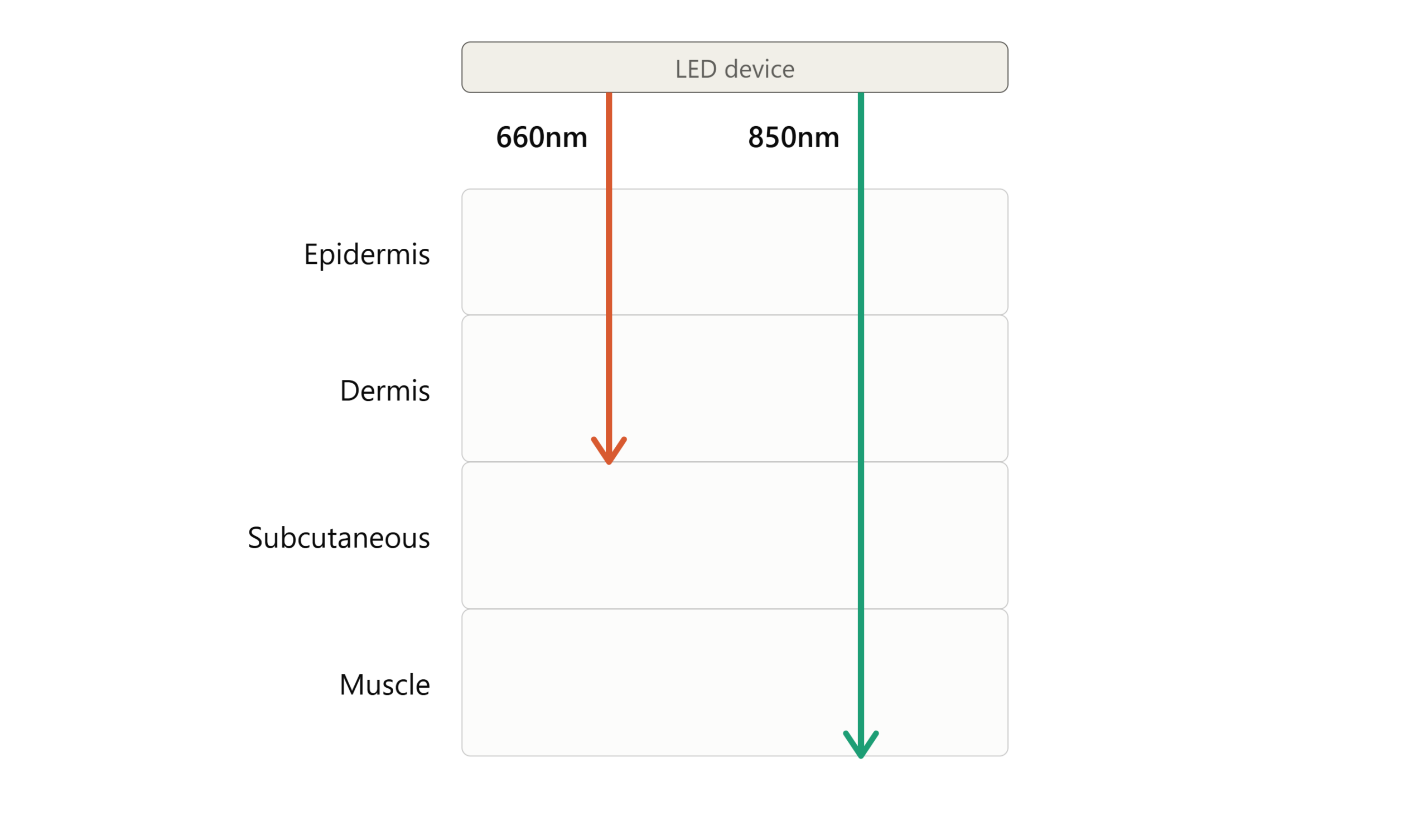
- 660nm (red light): This sits at the visible end of the spectrum and is generally associated with surface-level exposure, reaching the skin and upper tissue layers.
- 850nm (near-infrared light): This wavelength is invisible to the human eye and is generally understood to penetrate further into tissue than visible red light.
Devices that combine both wavelengths — often marketed as dual-wavelength or red and near-infrared light therapy systems — are designed to expose both the skin surface and deeper tissue in the same session, rather than requiring separate treatments for each.
When you’re comparing devices, wavelength accuracy matters more than the number of LEDs alone. A panel or mat that’s genuinely calibrated to 660nm and 850nm will behave differently than a cheaper device using approximate or unverified wavelengths, so it’s reasonable to look for manufacturers who disclose exact figures rather than vague ranges.
Red Light Therapy Mat vs Panel: The Core Differences
This is the heart of the comparison. Mats and blankets, and panels, are built around different design philosophies, and that shapes almost everything else — coverage, positioning, convenience, and price.
How a Red Light Therapy Panel Works
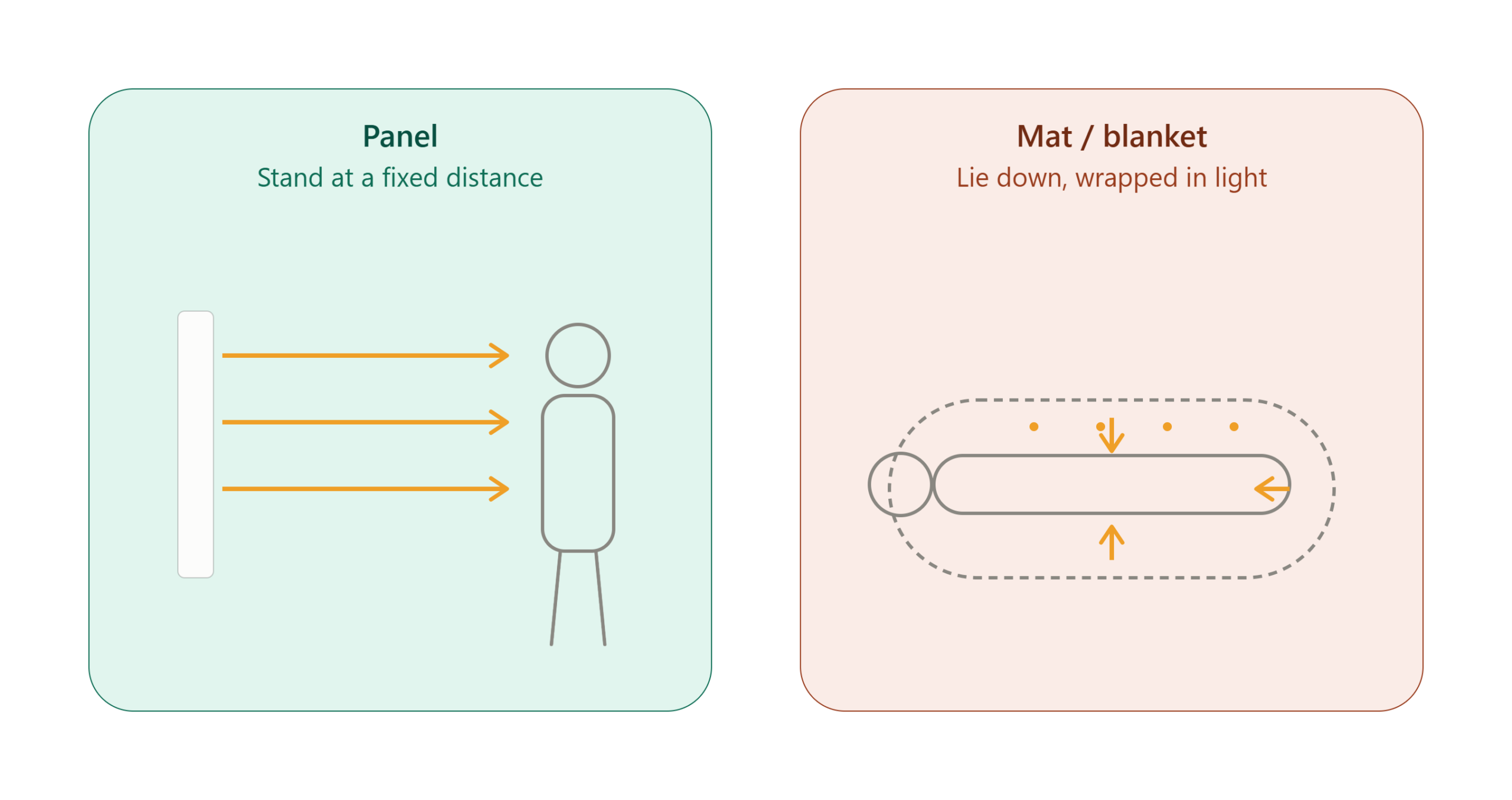
A panel is a flat, rigid unit, typically mounted on a stand or leaned against a wall, that emits light across a fixed surface area. You position your body (or the specific body part you’re treating) in front of the panel, at a set distance, for the duration of the session.
Panels are directional. They treat whatever surface is facing them, which means:
- One side of the body is exposed at a time; you generally reposition to treat the back, front, or a different limb.
- Distance from the panel affects irradiance, so consistent positioning session to session matters.
- Larger panels can cover more of the body per session, but “full body” panel setups usually mean either a very large panel or multiple panels arranged around a treatment space.
How a Red Light Therapy Mat or Blanket Works
Red light therapy devices commonly use specific wavelengths of red and near-infrared light. A mat or blanket, by contrast, is a flexible surface — often foldable — that wraps around or lies beneath the body. Because the LEDs are built into a flexible material rather than a rigid panel, the light source can conform to the body’s shape instead of the body conforming to a fixed light source.
This changes the practical experience in a few ways:
- The user typically lies down inside or on top of the mat, rather than standing at a set distance.
- Coverage tends to wrap around more of the body’s surface simultaneously, since the material folds around limbs, the torso, and other contours.
- Positioning is more passive — once you’re inside the blanket, the light source is already close to the skin across most of the treated area, rather than requiring the user to reposition for each body part.
Full-Body Coverage and Positioning: Where the Two Formats Really Diverge
Search interest in “full body red light therapy at home” usually comes from people who don’t want to spend a session methodically repositioning in front of a panel for their front, back, arms, and legs separately.
This is where the mat/blanket format has a structural advantage for full-body use. Because a mat like a red light therapy blanket is designed to fold around the body rather than emit light from a single flat plane, it’s built specifically to expose more surface area in one sitting — literally, since most cocoon-style blankets are used lying down.
Panels aren’t bad at coverage; they’re just built around a different use case. A single large panel does a good job on whatever surface is facing it, which makes panels well-suited to:
- Targeted areas — face, chest, shoulder, or a specific joint
- Standing sessions where you want to treat the front of the body
- Setups where you want to control the exact distance and angle of exposure
If your priority is genuinely full-body coverage without a lot of manual repositioning, a mat or blanket format is generally going to get you there in fewer steps. If your priority is precision on one area, a panel gives you more control over angle and distance.
Convenience, Portability, and Setup for Home Use
Home use is where format differences become daily-life differences. A few things to think through:
Panels usually require:
- A stand, wall mount, or door hook
- A dedicated spot in a room where you can stand or sit at a fixed distance
- More deliberate setup if you’re moving the panel between rooms
Mats and blankets usually offer:
- A foldable design that can be stored in a closet or under a bed
- Use directly on a bed, floor mat, or yoga mat, without needing wall space or a stand
- Easier travel between rooms since there’s no rigid frame
For anyone working with a small apartment, a shared space, or a routine that changes room to room, the portable and flexible nature of a mat is a meaningful practical advantage. For a dedicated home gym or wellness room with permanent space for a stand, a panel’s fixed setup is less of an issue.
Which Format Fits Athletes, Biohackers, and General Wellness Users?
Different users tend to gravitate toward different formats, based on how they actually use the device:
| User type | Common priority | Format that tends to fit |
|---|---|---|
| Athletes & fitness enthusiasts | Post-workout, full-body recovery routine | Mat/blanket — full-body exposure while lying down after training |
| Biohackers | Consistent, repeatable full-body sessions as part of a daily routine | Mat/blanket — passive, hands-free full-body use |
| General wellness users | Relaxation, unwinding, sleep-focused routines | Mat/blanket — comfortable lying-down sessions |
| Users targeting one area | A specific joint, the face, or a localized area | Panel — precise, directional exposure |
| Clinics or shared spaces | Flexibility to treat multiple people/areas quickly | Panel — quick setup for spot treatment |
This isn’t a hard rule — plenty of athletes use panels for targeted joint work, and plenty of general wellness users like the simplicity of a wall-mounted panel. But as a starting point, full-body recovery and passive daily-use routines tend to favor the mat/blanket format, while precision and spot-treatment routines tend to favor panels.
Key Buying Factors: What to Actually Check Before You Buy
Regardless of which format you lean toward, these are the factors worth comparing across devices:
- Wavelength accuracy. Look for manufacturers that specify exact wavelengths (e.g., 660nm and 850nm) rather than vague ranges like “red and infrared light.”
- LED density. More LEDs per square inch generally means more consistent coverage across the treated surface, though this should be weighed against irradiance and build quality, not judged on LED count alone.
- Coverage area. Measure the actual surface dimensions of the device (in inches) against your body size, not just the marketing description of “full body.”
- Construction and flexibility. For mats and blankets, check the outer material (waterproof or wipeable materials tend to hold up better over time) and how easily the unit folds for storage.
- Ease of use. Timer settings, remote controls, and pulse mode options all affect how consistently you’ll actually use the device — a device that’s a hassle to set up tends to get used less.
- EMF design. Some manufacturers specify low-EMF construction; if this matters to you, check the product specifications directly rather than assuming.
Portable Red Light Therapy: A Middle Ground Worth Knowing About
It’s also worth mentioning that “portable” doesn’t only describe small handheld devices. Foldable mats and blankets are, by design, more portable than a panel-and-stand setup, even though they cover a large surface area. If portability and full-body coverage both matter to you, that combination is really only available in the mat/blanket category — panels covering equivalent surface area are typically large, multi-panel setups that aren’t practical to fold up and move.
Where a Full-Body Blanket Fits: A Practical Example
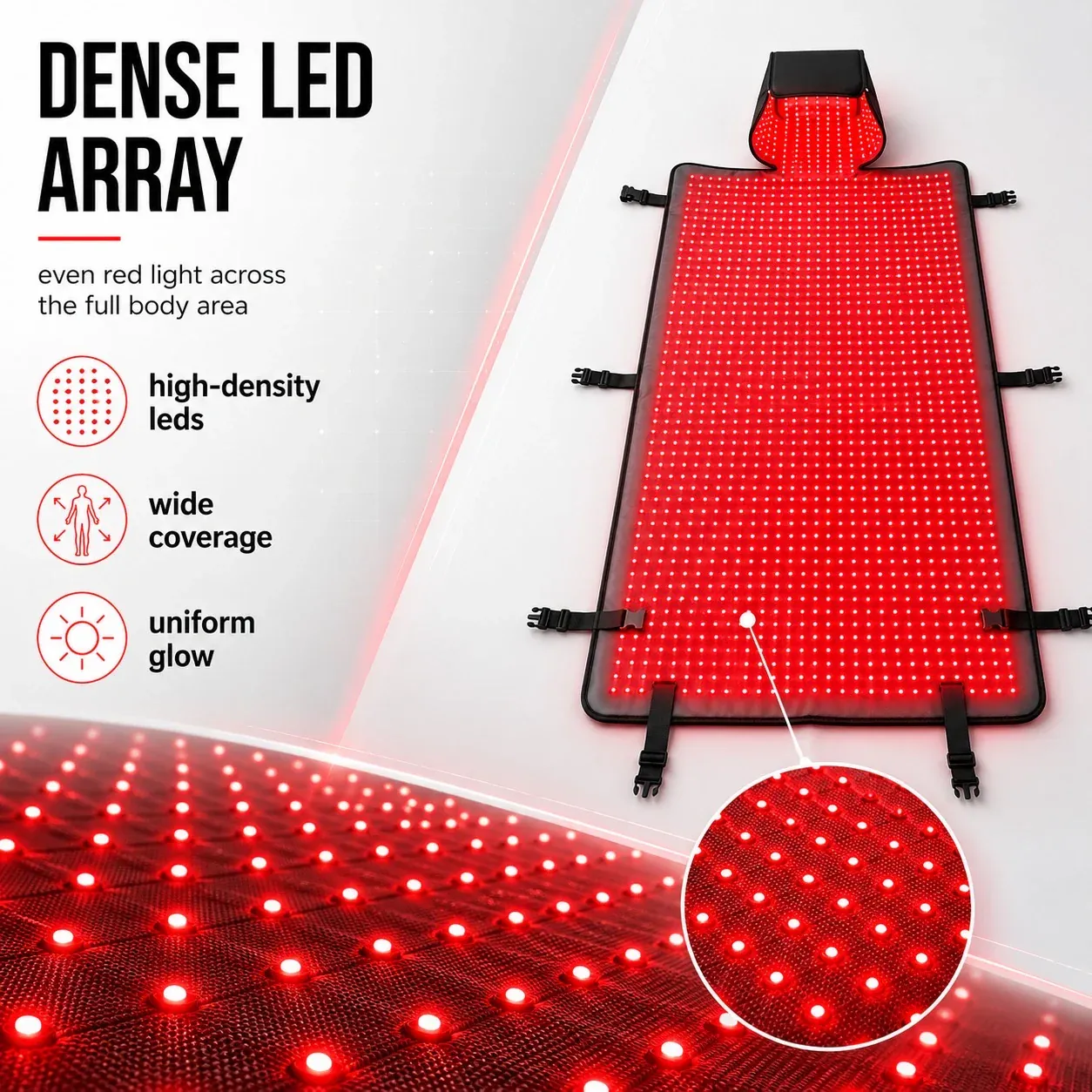
To make this comparison concrete, it helps to look at how a full-body mat is actually built. The LuxReda Extra Large Red Light Therapy Mat Blanket is an example of the blanket format described above — a foldable, cocoon-style design built around 660nm red light and 850nm near-infrared light, using high-density LEDs across a 98″ x 32″ surface area. It includes an adjustable timer (10–90 minutes), pulse mode, low-EMF construction, and a waterproof neoprene exterior with a latex-free PVC interior lining.
That combination — wrap-around coverage, a foldable design for storage, and dual-wavelength LEDs — is fairly representative of what separates the mat/blanket category from a standing panel: it’s built for someone who wants to lie down and expose a large portion of the body to red and near-infrared light in one session, rather than standing at a set distance and repositioning between body parts.
If you’re specifically evaluating a red light therapy blanket for home use, checking the coverage dimensions and wavelength specifications against your own body size and routine is a reasonable next step before comparing it to a panel setup.
Red Light Therapy Mat vs Panel: Quick Comparison
| Factor | Mat / Blanket | Panel |
|---|---|---|
| Full-body coverage per session | Higher — body wraps into the light source | Lower per angle — usually treats one side at a time |
| Positioning | Passive; lie down and the light conforms to the body | Active; stand or sit at a fixed distance, reposition as needed |
| Portability | Foldable, easy to store and move | Requires a stand or wall mount; less portable |
| Best suited for | Full-body recovery, relaxation, daily routines | Targeted areas, precise angle/distance control |
| Setup space | Minimal — a bed, floor, or yoga mat | Dedicated standing or seated space |
Frequently Asked Questions
Is a red light therapy mat better than a panel for full-body treatment? For genuinely full-body sessions in a single sitting, a mat or blanket format generally offers more coverage per session because it wraps around the body rather than emitting light from one flat direction. A panel can still be used for full-body treatment, but it typically requires repositioning to cover the front, back, and limbs separately.
Can I use a red light therapy blanket every day? Session frequency and duration should follow the specific manufacturer’s instructions for your device, since timer ranges and recommended use vary by product. If you have a health condition or are unsure, check with a healthcare provider before starting a daily routine.
What’s the difference between 660nm and 850nm light therapy? 660nm is visible red light generally associated with surface-level skin exposure, while 850nm is near-infrared light, invisible to the eye, generally understood to reach further into tissue. Devices that combine both wavelengths are designed to expose the skin surface and deeper tissue layers in the same session.
Are red light therapy mats portable? Most mats and blankets are designed to fold for storage and transport, which makes them more portable than a panel-and-stand setup, particularly for full-body coverage devices.
Do red light therapy panels cover the whole body? A single panel typically covers whichever surface faces it at a given distance, so full-body treatment with a panel usually means repositioning between sessions or using multiple panels arranged around a treatment space.
Is red light therapy the same as UV tanning? No. Red and near-infrared light therapy uses different wavelengths than UV tanning equipment, and it works on a different principle. This article and its comparisons refer specifically to red (660nm) and near-infrared (850nm) light therapy devices, not UV tanning beds. If you separately use UV tanning equipment, follow the manufacturer’s instructions and applicable FDA guidance — UV tanning carries its own set of risks and should not be treated as risk-free.
Which is better for athletes: a red light therapy mat or panel? Athletes using red light therapy as part of a post-workout recovery routine often prefer the mat/blanket format because it allows a full-body, lie-down session without needing to reposition for different muscle groups. Athletes focused on a single joint or muscle group may prefer the precision of a panel instead.
Final Thoughts
There isn’t a single “better” format between a red light therapy mat and a panel — there’s a better fit for your specific routine. If your goal is full-body coverage with minimal repositioning, a foldable mat or blanket, like a full-body red light therapy blanket, is built for exactly that. If your goal is targeted, precise treatment of one area at a time, a panel gives you more control over distance and angle.
Before buying either format, compare the actual specifications — wavelength accuracy, coverage dimensions, LED density, and construction — rather than relying on marketing language alone. That’s the information that will actually tell you how a device performs, regardless of which format you choose.
Both red light therapy panels and mats can have a place in a home wellness routine. The goal is to find a red light therapy setup that is comfortable, practical, and easy for you to use regularly.
Take care of your health, stay active, keep smiling, and make time for your wellness. Small healthy habits can make a positive difference in everyday life. Choose wellness products that fit your routine, take care of yourself, and enjoy every day with more comfort and confidence. Stay well, stay positive, and keep smiling!
Thank you